
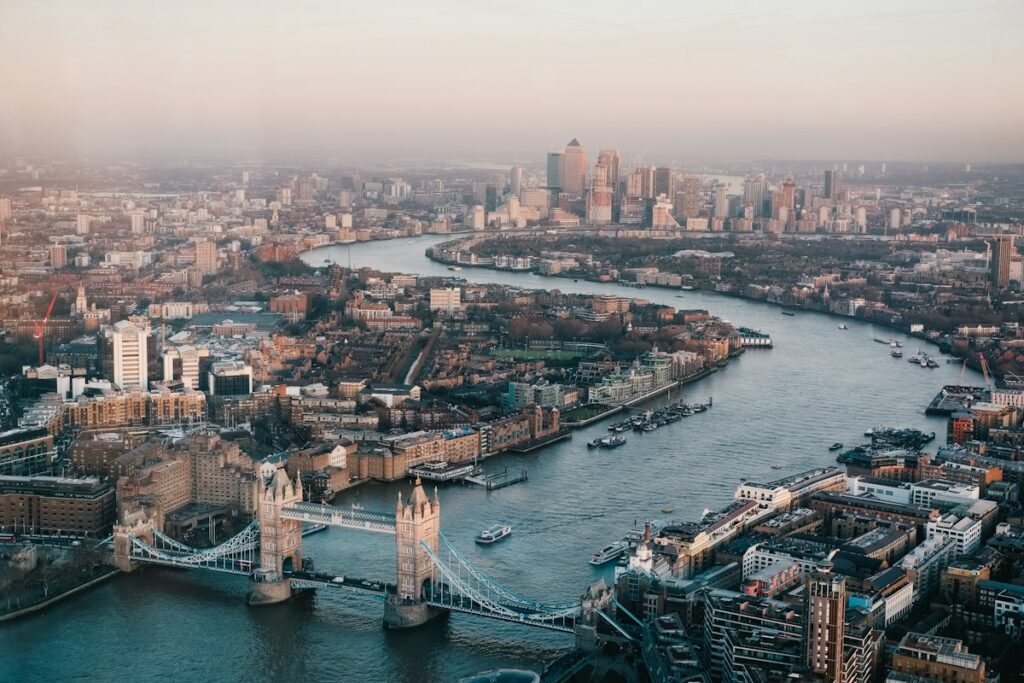
Executive Brief: London Metropolitan Local Search & Borough Proximity Engineering
London represents one of the most commercially concentrated and competitive local search environments on earth, encompassing 32 distinct boroughs, over 9 million residents, and hundreds of thousands of registered enterprises competing across high-density commercial hubs from Mayfair and the City to Canary Wharf and Shoreditch. Operating in this environment requires overcoming severe algorithmic proximity constraints, high local click costs on paid media, and multi-location citation fragmentation. A specialized London local SEO agency engineers borough-level entity graphs, automated Google Business Profile workflows, and hyper-localized structured data to command persistent top-3 map pack visibility across Greater London.
1. The Geometry of London Local Search: Navigating Borough Boundaries & Density
Local search in Greater London differs fundamentally from regional provincial markets. While a business in Manchester or Birmingham might capture localized search interest across an entire metropolitan area from a single central office, London’s extreme commercial density triggers aggressive proximity radius decay within Google’s local pack algorithms. A private wealth boutique or specialist dental clinic located in Marylebone may rank #1 on Baker Street, yet fall to position #14 just 1.5 miles away in Fitzrovia or Covent Garden.
Overcoming this localized visibility collapse requires engineering borough-specific entity silos that signal distinct geographic relevance to Google’s neural matching models without triggering spam flags. Companies that rely on generic city-wide pages forfeit over 65% of high-intent transactional search clicks to neighborhood competitors.
| Local Ranking Vector | Generic London Agency Approach | Institutional London Borough Entity Architecture |
|---|---|---|
| Geographic Targeting | Single generic ‘London’ landing page targeting the entire capital | Borough and neighborhood specific silos (e.g., Westminster, Camden, Islington, City) |
| GBP Category Configuration | Single broad primary category without secondary refinement | Audited primary category paired with 6-8 verified secondary categories and localized service menus |
| Citation Graph | Automated international directory blast on low-authority sites | Verified UK commercial registers (Companies House, Scoot, 192.com, Yell, Thomson Local) |
| Schema Integration | Basic Organization schema with missing postal coordinates | Nested LocalBusiness JSON-LD with exact geo-coordinates, borough disambiguation, and opening hours |
| Review Acquisition | Passive customer feedback collection without NLP intent | Automated SMS/Email post-service funnels targeting borough-specific keyword feedback |
| Transit & Landmark Signals | No public transport references | Explicit proximity schema referencing London Underground stations, TfL routes, and major landmarks |
2. Borough-Level Entity Graph Engineering: Grounding Listings in the London Schema
Google’s local algorithms evaluate entities within the Knowledge Graph by reconciling physical real-world data points. To outrank competing businesses in Central London, organizations must deploy precise structured linked data that establishes geographic and corporate legitimacy:
A. London Underground & Transport Proximity Schema
In London, consumer movement and commercial catchment areas are dictated by Transport for London (TfL) transit hubs. Incorporating structured transit proximity references into your website DOM signals real-world accessibility:
{
  "@context": "https://schema.org",
  "@graph": [
    {
      "@type": "FinancialService",
      "@id": "https://seotraffichero.com/locations/london-mayfair/#service",
      "name": "Mayfair Corporate Wealth Advisory",
      "url": "https://seotraffichero.com/locations/london-mayfair/",
      "telephone": "+44-20-7946-0921",
      "address": {
        "@type": "PostalAddress",
        "streetAddress": "42 Berkeley Square",
        "addressLocality": "Mayfair",
        "addressRegion": "London",
        "postalCode": "W1J 5AW",
        "addressCountry": "GB"
      },
      "geo": {
        "@type": "GeoCoordinates",
        "latitude": "51.5095",
        "longitude": "-0.1467"
      },
      "areaServed": [
        {
          "@type": "AdministrativeArea",
          "name": "City of Westminster"
        },
        {
          "@type": "AdministrativeArea",
          "name": "Royal Borough of Kensington and Chelsea"
        }
      ],
      "amenityFeature": [
        {
          "@type": "LocationFeatureSpecification",
          "name": "Proximity to Green Park Underground Station",
          "value": "350 meters"
        }
      ]
    }
  ]
}
B. Companies House & FCA Registry Disambiguation
For corporate, legal, and financial services operating in London, local ranking prominence is directly correlated with regulatory transparency. Embedding verified Companies House registration numbers and Financial Conduct Authority (FCA) reference links within corporate schemas eliminates algorithmic distrust and strengthens domain authority.
3. Quantitative Valuation: London Local 3-Pack Commercial Economics
Paid search advertising in London represents some of the highest cost-per-click (CPC) rates in global digital marketing. In verticals such as commercial litigation, corporate insolvency, private healthcare, and commercial property, bidding on London-targeted Google Ads costs between £15.00 and £85.00 per click.
Dominating the organic Google Local 3-Pack builds an asset that captures high-intent transactional calls and booking inquiries at a fraction of ongoing paid advertising expense.
Formula: London Local 3-Pack Pipeline & Media Cost Displacement
Organic Local CPA (£) = Monthly Local Retainer Spend / Verified Converted High-Value Clients
Net Annual Generated Pipeline (£) = High-Intent Map Inquiries × Booking Rate % × Average Client Lifetime Value (LTV)
Paid Search Cost Equivalent (£) = Total Map Pack Interactions × Vertical Benchmark Paid CPC
Empirical Central London Commercial Advisory Simulation (Westminster & City):
• Target Geography: City of London, Westminster, Camden, Canary Wharf
• Combined Monthly High-Intent Commercial Searches: 24,500 queries
• Baseline Map Pack Presence (Rank 7-11): Share of Voice = 3.8% → 931 impressions
• Post-Optimization Local 3-Pack Placement (Rank 1-3): Share of Voice = 44.0% → 10,780 impressions
• Map Action Rate (Website Clicks, Direct Phone Calls, Directions): 13.8% → 1,487 High-Intent Inquiries / Month
• Qualified Consultation Booking Rate: 22% → 327 Qualified Consultations / Month
• Consultation to Client Retainer Close Rate: 18% → 58.8 Retained Corporate Clients / Month
• Average Client Engagement Value: £4,500
• Monthly Generated Revenue Pipeline = 58.8 × £4,500 = £264,600 / month
• Annualized Corporate Local Revenue = 58.8 × £4,500 × 12 = £3,175,200 in recurring client value
• Monthly London Local SEO Retainer Investment: £3,800 / month (£45,600 annually)
• Blended Client Acquisition Cost = £3,800 / 58.8 clients = £64.62 per enterprise client
• Paid Google Ads Comparative Cost: 1,487 clicks × £28.50 average CPC = £42,379 / month (£508,548 annually)
• Annual Paid Advertising Savings = £508,548 – £45,600 = £462,948 in direct capital preservation
• Program Return on Investment = (£3,175,200 – £45,600) / £45,600 × 100 = 6,863% ROI
This mathematical proof illustrates how controlling London local search results generates multi-million-pound commercial returns while insulating corporate budgets from escalating pay-per-click bidding wars.
4. Geo-Grid Telemetry & Micro-Proximity Tracking Across London Boroughs
Measuring local ranking performance via a single desktop browser in Soho provides a distorted view of actual market visibility. To evaluate true borough penetration, search architects deploy geo-grid ranking matrices configured at 250-meter to 500-meter intervals across targeted postal codes (e.g., EC1 to EC4, W1, SW1, WC1, E14).
By monitoring color-coded ranking heatmaps across postal code clusters, teams identify geographic friction zones where algorithmic prominence falls off. These drop-offs are systematically resolved by creating neighborhood-specific landing hubs featuring localized case studies, client testimonials from specific boroughs, and neighborhood transit instructions, expanding the rank 1-3 footprint outward.
5. UK Citation Authority & NAP Synchronization Desks
Building local authority in the United Kingdom requires securing consistent Name, Address, and Phone (NAP) citations across established British directories and regulatory registers:
- Tier-1 British Commercial Registers: Companies House, Dun & Bradstreet UK, Scoot, 192.com, Yell, Thomson Local, and British Chamber of Commerce directories.
- Industry-Specific Professional Registers: Law Society of England and Wales, General Medical Council (GMC), Institute of Chartered Accountants in England and Wales (ICAEW), and Royal Institution of Chartered Surveyors (RICS).
- Borough Chamber Listings: Westminster Chamber of Commerce, London Chamber of Commerce and Industry (LCCI), and East London Business Alliance.
6. Natural Language Processing (NLP) & Review Sentiment Engineering
Google’s local ranking neural networks analyze customer reviews to extract semantic entity associations. When clients organically include location descriptors and service attributes (e.g., ‘exceptional corporate tax planning in Mayfair’ or ‘speedy emergency commercial plumbing in Canary Wharf’), Google’s algorithms weight the profile higher for those specific long-tail queries.
Deploying automated post-engagement feedback workflows encourages satisfied commercial clients to leave descriptive feedback that naturally incorporates targeted geographic and operational keywords, strengthening review velocity and local search prominence.
7. Multi-Location London Medical & Legal Practice Hierarchies
For private medical clinics operating across Harley Street, Chelsea, and Wimbledon, or commercial law chambers maintaining branches in the Temple and Canary Wharf, local search requires a rigorous multi-location technical hierarchy:
- Sub-Directory Neighborhood Hubs: Avoid grouping multiple London practices on a generic directory page. Build distinct, indexable hubs (e.g.,
/clinics/harley-street/and/clinics/wimbledon/) complete with consultant GMC registration numbers, local appointment calendars, and street photography. - Granular Healthcare & Legal Schemas: Annotate each practice page with nested
MedicalClinicorAttorneyJSON-LD schemas incorporating specific medical specializations, hospital admitting privileges, and verified Law Society accreditation badges. - Direct TfL Travel Directions: Embed custom transit itineraries detailing bus lines, step-free access routes, and nearby pay-and-display parking zones, providing immense real-world value for prospective patients and clients.
8. Five-Phase Tactical Walkthrough: Dominating London Local Search
Executing an enterprise local search overhaul across Greater London requires systematic deployment:
- GBP Audit & Primary Category Alignment: Reclaim fragmented profiles, audit primary and secondary categories against top-ranking London competitors, and verify physical commercial lease documentation.
- Borough & Transit Landing Page Deployment: Build dedicated, mobile-optimized borough and neighborhood landing pages featuring unique local copy, staff credentials, transit instructions, and embedded Google Maps.
- Nested JSON-LD LocalBusiness Schema Injection: Annotate landing pages with structured data embedding exact latitude/longitude coordinates, Companies House registration numbers, and official borough boundaries.
- UK NAP Citation Synchronization: Clean up and align NAP information across major British business directories, professional associations, and London chamber registers.
- Automated Review Generation & Sentiment Acceleration: Implement automated client feedback funnels to maintain consistent review acquisition and reinforce localized sentiment signals.
9. Frequently Asked Questions (FAQ)
Can a London business rank in boroughs where it does not have a physical office?
While Google’s local map pack strongly prioritizes businesses located within immediate physical proximity to the searcher, companies can expand their organic map radius into adjacent boroughs through dedicated borough landing pages, localized schema markup, and neighborhood citation building.
Why do virtual offices in Central London fail to rank in Google Maps?
Google employs sophisticated algorithmic filters and street-level verification teams that flag shared co-working spaces and mail-drop addresses. Profiles registered at known virtual office addresses without dedicated signage or permanent staff frequently suffer automated suspension or ranking suppression.
How long does it take to rank in the Google 3-Pack in London?
For low to medium competition commercial queries, technical GBP optimization and citation alignment typically deliver top-3 map pack placements within 60 to 90 days. For highly competitive Central London verticals (legal, wealth management, luxury healthcare), dominating multiple boroughs requires 4 to 6 months of disciplined optimization.